Poverty is a state or condition in which a person or community lacks the financial resources and essentials for a minimum standard of living. Poverty means that the income level from employment is so low that basic human needs can't be met.
According to World Bank, Poverty is pronounced deprivation in well-being, and comprises many dimensions. It includes low incomes and the inability to acquire the basic goods and services necessary for survival with dignity. Poverty also encompasses low levels of health and education, poor access to clean water and sanitation, inadequate physical security, lack of voice, and insufficient capacity and opportunity to better one's life.
In India, 21.9% of the population lives below the national poverty line in 2011.
In 2018, almost 8% of the world’s workers and their families lived on less than US$1.90 per person per day (international poverty line).
Types of Poverty: There are two main classifications of poverty:
Absolute Poverty: A condition where household income is below a necessary level to maintain basic living standards (food, shelter, housing). This condition makes it possible to compare between different countries and also over time.
It was first introduced in 1990, the “dollar a day” poverty line measured absolute poverty by the standards of the world's poorest countries. In October 2015, the World Bank reset it to $1.90 a day.
Relative Poverty: It is defined from the social perspective that is living standard compared to the economic standards of population living in surroundings. Hence it is a measure of income inequality.
Usually, relative poverty is measured as the percentage of the population with income less than some fixed proportion of median income.
Poverty estimation in India is carried out by NITI Aayog’s task force through the calculation of poverty line based on the data captured by the National Sample Survey Office under the Ministry of Statistics and Programme Implementation (MOSPI).
Poverty line estimation in India is based on the consumption expenditure and not on the income levels.
Poverty is measured based on consumer expenditure surveys of the National Sample Survey Organisation. A poor household is defined as one with an expenditure level below a specific poverty line.
The incidence of poverty is measured by the poverty ratio, which is the ratio of the number of poor to the total population expressed as a percentage. It is also known as head-count ratio.
Alagh Committee (1979) determined a poverty line based on a minimum daily requirement of 2400 and 2100 calories for an adult in Rural and Urban area respectively.
Subsequently different committees; Lakdawala Committee (1993), Tendulkar Committee (2009), Rangarajan committee (2012) did the poverty estimation.
As per the Rangarajan committee report (2014), the poverty line is estimated as Monthly Per Capita Expenditure of Rs. 1407 in urban areas and Rs. 972 in rural areas.
Causes of Poverty in India
Population Explosion: India’s population has steadily increased through the years. During the past 45 years, it has risen at a rate of 2.2% per year, which means, on average, about 17 million people are added to the country’s population each year. This also increases the demand for consumption goods tremendously.
Low Agricultural Productivity: A major reason for poverty in the low productivity in the agriculture sector. The reason for low productivity is manifold. Chiefly, it is because of fragmented and subdivided land holdings, lack of capital, illiteracy about new technologies in farming, the use of traditional methods of cultivation, wastage during storage, etc.
Inefficient Resource utilisation: There is underemployment and disguised unemployment in the country, particularly in the farming sector. This has resulted in low agricultural output and also led to a dip in the standard of living.
Low Rate of Economic Development: Economic development has been low in India especially in the first 40 years of independence before the LPG reforms in 1991.
Price Rise: Price rise has been steady in the country and this has added to the burden the poor carry. Although a few people have benefited from this, the lower income groups have suffered because of it, and are not even able to satisfy their basic minimum wants.
Unemployment: Unemployment is another factor causing poverty in India. The ever-increasing population has led to a higher number of job-seekers. However, there is not enough expansion in opportunities to match this demand for jobs.
Lack of Capital and Entrepreneurship: The shortage of capital and entrepreneurship results in low level of investment and job creation in the economy.
Social Factors: Apart from economic factors, there are also social factors hindering the eradication of poverty in India. Some of the hindrances in this regard are the laws of inheritance, caste system, certain traditions, etc.
Colonial Exploitation: The British colonisation and rule over India for about two centuries de-industrialised india by ruining its traditional handicrafts and textile industries. Colonial Policies transformed india to a mere raw-material producer for european industries.
Climatic Factors: Most of india’s poor belong to the states of Bihar, UP, MP, Chhattisgarh, odisha, Jharkhand, etc. Natural calamities such as frequent floods, disasters, earthquake and cyclone cause heavy damage to agriculture in these states.
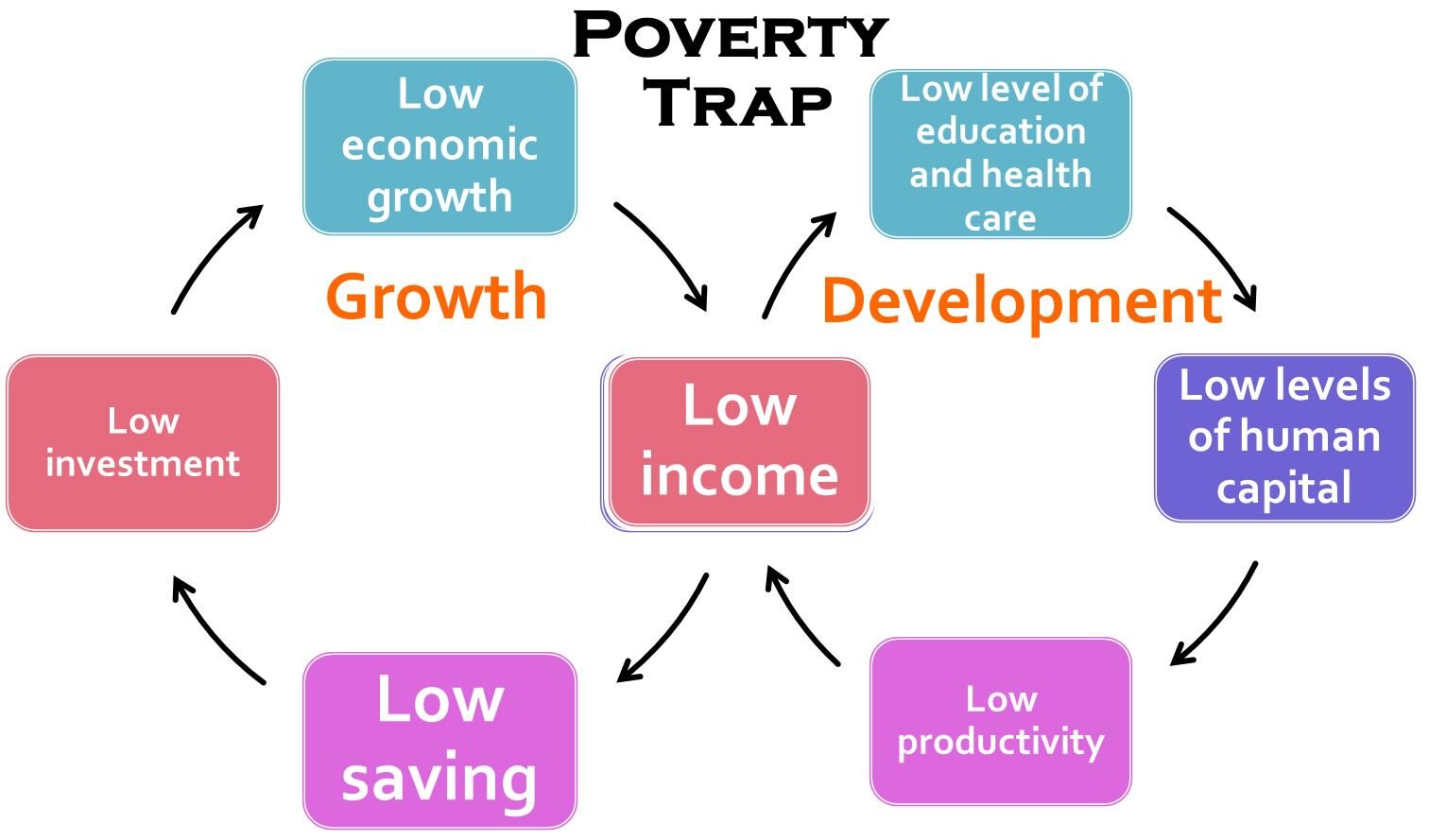
Poverty Trap:
Poverty Alleviation Programs in India
Integrated Rural Development Programme (IRDP): It was introduced in 1978-79 and universalized from 2nd October, 1980, aimed at providing assistance to the rural poor in the form of subsidy and bank credit for productive employment opportunities through successive plan periods.
Jawahar Rozgar Yojana/Jawahar Gram Samridhi Yojana: The JRY was meant to generate meaningful employment opportunities for the unemployed and underemployed in rural areas through the creation of economic infrastructure and community and social assets.
Rural Housing – Indira Awaas Yojana: The Indira Awaas Yojana (LAY) programme aims at providing free housing to Below Poverty Line (BPL) families in rural areas and main targets would be the households of SC/STs.
Food for Work Programme: It aims at enhancing food security through wage employment. Food grains are supplied to states free of cost, however, the supply of food grains from the Food Corporation of India (FCI) godowns has been slow.
National Old Age Pension Scheme (NOAPS): This pension is given by the central government. The job of implementation of this scheme in states and union territories is given to panchayats and municipalities. The states contribution may vary depending on the state. The amount of old age pension is ₹200 per month for applicants aged 60–79. For applicants aged above 80 years, the amount has been revised to ₹500 a month according to the 2011–2012 Budget. It is a successful venture.
Annapurna Scheme: This scheme was started by the government in 1999–2000 to provide food to senior citizens who cannot take care of themselves and are not under the National Old Age Pension Scheme (NOAPS), and who have no one to take care of them in their village. This scheme would provide 10 kg of free food grains a month for the eligible senior citizens. They mostly target groups of ‘poorest of the poor’ and ‘indigent senior citizens’.
Sampoorna Gramin Rozgar Yojana (SGRY): The main objective of the scheme continues to be the generation of wage employment, creation of durable economic infrastructure in rural areas and provision of food and nutrition security for the poor.
Mahatma Gandhi National Rural Employment Guarantee Act (MGNREGA) 2005: The Act provides 100 days assured employment every year to every rural household. One-third of the proposed jobs would be reserved for women. The central government will also establish National Employment Guarantee Funds. Similarly, state governments will establish State Employment Guarantee Funds for implementation of the scheme. Under the programme, if an applicant is not provided employment within 15 days s/he will be entitled to a daily unemployment allowance.
National Rural Livelihood Mission: Aajeevika (2011): It evolves out the need to diversify the needs of the rural poor and provide them jobs with regular income on a monthly basis. Self Help groups are formed at the village level to help the needy.
National Urban Livelihood Mission: The NULM focuses on organizing urban poor in Self Help Groups, creating opportunities for skill development leading to market-based employment and helping them to set up self-employment ventures by ensuring easy access to credit.
Pradhan Mantri Kaushal Vikas Yojana: It will focus on fresh entrant to the labour market, especially labour market and class X and XII dropouts.
Pradhan Mantri Jan Dhan Yojana: It aimed at direct benefit transfer of subsidy, pension, insurance etc. and attained the target of opening 1.5 crore bank accounts. The scheme particularly targets the unbanked poor.
“We are committed to achieving the Sustainable Development Goals and building a safer and more sustainable world for children everywhere.” – Claire Rogers
The consequences of poverty are far-reaching and long-lasting, including child deaths, lack of access to education and food insecurity, all of which can be caused by poverty and in turn can perpetuate it.
Six million people living in makeshift camps in western Afghanistan
Camp in Bangladesh that was destroyed by fire in 2019.
Poverty is responsible for the deaths of more than six million children before their fifth birthdays, and a child under 15 dies every five seconds around the world. Poverty contributes to a lack of access to healthcare and immunisations, as well as to proper nutrition, leaving children vulnerable to mostly preventable illnesses such as pneumonia, diarrhoea and malaria. Malnutrition is responsible for 45 percent of all deaths in children aged under five.
The situation is improving, and the number of deaths has fallen. In the late 1960s, 20 million children under the age of five died every year. In 1990 it was 12 million. However, almost 805 million people in the world – one in nine – don’t have enough access to food.
Drought, a lack of money, low productivity and poor health and limited education among farmers all contribute to food insecurity. A natural disaster or conflict, like the current situation facing Rohingya people who fled from Myanmar to Bangladesh, can further exacerbate an inability to access food, and families living in poverty are less able to make up the shortfall when markets change dramatically.
World Vision addresses both the short-term and long-term causes of hunger and food insecurity in many countries around the world, by teaching farmers how to nurture their land, prevent soil degradation and increase sustainability and productivity. We also provide farmers with new varieties of seed that are both more productive and nutritious, and training in improved agricultural techniques.
When food is assured and children don’t have to contribute to providing food, water and firewood to a household, they can focus on the education that will help lift them and their own children out of poverty.
Educated mothers, for example, are better informed about healthcare and appropriate nutrition, and raise healthier children. Education also results in higher wages and economic growth, with each additional year of schooling equating to a 10 percent increase in wages.
Poverty and its effects
45%
child mortality rate
Malnutrition is responsible for 45 percent of all deaths in children aged under five
805 million
people
Almost 805 million people in the world – one in nine – don’t have access to enough food
$1.90
living cost per day
People living in extreme poverty live on less than $1.90 a day
Mental health effects of poverty, hunger, and homelessness on children and teens
Rising inflation and an uncertain economy are deeply affecting the lives of millions of Americans, particularly those living in low-income communities. It may seem impossible for a family of four to survive on just over $27,000 per year or a single person on just over $15,000, but that’s what millions of people do everyday in the United States. Approximately 37.9 million Americans, or just under 12%, now live in poverty, according to the U.S. Census Bureau.
Additional data from the Bureau show that children are more likely to experience poverty than people over the age of 18. Approximately one in six kids, 16% of all children, live in families with incomes below the official poverty line.
Those who are poor face challenges beyond a lack of resources. They also experience mental and physical issues at a much higher rate than those living above the poverty line. Read on for a summary of the myriad effects of poverty, homelessness, and hunger on children and youth. And for more information on APA’s work on issues surrounding socioeconomic status, please see the Office of Socioeconomic Status.
Who is most affected?
Poverty rates are disproportionately higher among most non-White populations. Compared to 8.2% of White Americans living in poverty, 26.8% of American Indian and Alaska Natives, 19.5% of Blacks, 17% of Hispanics and 8.1% of Asians are currently living in poverty.
Similarly, Black, Hispanic, and Indigenous children are overrepresented among children living below the poverty line. More specifically, 35.5% of Black people living in poverty in the U.S. are below the age of 18. In addition, 40.7% of Hispanic people living below the poverty line in the U.S. are younger than age 18, and 29.1% of American Indian and Native American children lived in poverty in 2018. In contrast, approximately 21% of White people living in poverty in the U.S. are less than 18 years old.
Furthermore, families with a female head of household are more than twice as likely to live in poverty compared to families with a male head of household. Twenty-three percent of female-headed households live in poverty compared to 11.4% of male-headed households, according to the U.S. Census Bureau.
What are the effects of poverty on children and teens?
The impact of poverty on young children is significant and long lasting. Poverty is associated with substandard housing, hunger, homelessness, inadequate childcare, unsafe neighborhoods, and under-resourced schools. In addition, low-income children are at greater risk than higher-income children for a range of cognitive, emotional, and health-related problems, including detrimental effects on executive functioning, below average academic achievement, poor social emotional functioning, developmental delays, behavioral problems, asthma, inadequate nutrition, low birth weight, and higher rates of pneumonia.
Children and families living in poverty often attend under-resourced, overcrowded schools that lack educational opportunities, books, supplies, and appropriate technology due to local funding policies. In addition, families living below the poverty line often live in school districts without adequate equal learning experiences for both gifted and special needs students with learning differences and where high school dropout rates are high.
What are the effects of hunger on children and teens?
One in eight U.S. households with children, approximately 12.5%, could not buy enough food for their families in 2021, considerably higher than the rate for households without children (9.4%). Black (19.8%) and Latinx (16.25%) households are disproportionately impacted by food insecurity, with food insecurity rates in 2021 triple and double the rate of White households (7%), respectively.
Research has found that hunger and undernutrition can have a host of negative effects on child development. For example, maternal undernutrition during pregnancy increases the risk of negative birth outcomes, including premature birth, low birth weight, smaller head size, and lower brain weight. In addition, children experiencing hunger are at least twice as likely to report being in fair or poor health and at least 1.4 times more likely to have asthma, compared to food-secure children.
What are the effects of homelessness on children and teens?
Approximately 1.2 million public school students experienced homelessness during the 2019-2020 school year, according to the National Center for Homeless Education (PDF, 1.4MB). The report also found that students of color experienced homelessness at higher proportions than expected based on the overall number of students. Hispanic and Latino students accounted for 28% of the overall student body but 38% of students experiencing homelessness, while Black students accounted for 15% of the overall student body but 27% of students experiencing homelessness. While White students accounted for 46% of all students enrolled in public schools, they represented 26% of students experiencing homelessness.
Homelessness can have a tremendous impact on children, from their education, physical and mental health, sense of safety, and overall development. Children experiencing homelessness frequently need to worry about where they will live, their pets, their belongings, and other family members. In addition, homeless children are less likely to have adequate access to medical and dental care, and may be affected by a variety of health challenges due to inadequate nutrition and access to food, education interruptions, trauma, and disruption in family dynamics.
In terms of academic achievement, students experiencing homelessness are more than twice as likely to be chronically absent than non-homeless students, with greater rates among Black and Native American or Alaska Native students. They are also more likely to change schools multiple times and to be suspended—especially students of color.
Further, research shows that students reporting homelessness have higher rates of victimization (PDF, 10MB), including increased odds of being sexually and physically victimized, and bullied. Student homelessness correlates with other problems, even when controlling for other risks. They experienced significantly greater odds of suicidality, substance abuse, alcohol abuse, risky sexual behavior, and poor grades in school.
What can you do to help children and families experiencing poverty, hunger, and homelessness?
There are many ways that you can help fight poverty in America. You can:
Volunteer your time with charities and organizations that provide assistance to low-income and homeless children and families.
Donate money, food, and clothing to homeless shelters and other charities in your community.
Donate school supplies and books to underresourced schools in your area.
Make your voice heard! Support public policy initiatives that seek to:
Improve access to physical, mental, and behavioral health care for low-income Americans by eliminating barriers such as limitations in health care coverage.
Create a “safety net” for children and families that provides real protection against the harmful effects of economic insecurity.
Increase the minimum wage, affordable housing and job skills training for low-income and homeless Americans.
Intervene in early childhood to support the health and educational development of low-income children.
Increase resources for public education and access to higher education.
Support research on poverty and its relationship to health, education, and well-being.
Conclusion
The Global Multidimensional Poverty Index-2018 released by the UN noted that 271 million people moved out of poverty between 2005-06 and 2015-16 in India. The poverty rate in the country has nearly halved, falling from 55% to 28% over the ten-year period. Still a big part of the population in india is living Below the Poverty Line.
Rapid economic growth and the use of technology for social sector programs have helped make a significant dent in extreme poverty in the country.
Despite rapid growth and development, an unacceptably high proportion of our population continues to suffer from severe and multidimensional deprivation. Thus, a more comprehensive and inclusive approach is required to eradicate poverty in India.






Comments
Post a Comment